

News & Resources
First Quarter 2026 Market Review
Financial market review for the first half of 2026
A volatile start to the year driven by geopolitical escalation, rising energy prices, and shifting inflation dynamics — and what it means for your portfolio going forward.
The Quarter in Context
The first quarter of 2026 proved to be one of the more volatile starts to a year in recent memory. What began as a regional geopolitical event — the outbreak of conflict involving Iran in late February — quickly evolved into a global macroeconomic shock with significant implications across asset classes.
The Trigger Escalating conflict in the Middle East involving Iran, beginning in late February 2026
The Transmission Instability around the Strait of Hormuz — a critical passageway for global oil supply —disrupted energy
markets

The Impact Oil prices surged, inflation pressures reemerged, and volatility spread across regions and asset classes
U.S. Markets: Resilient but Not Immune
U.S. equities demonstrated relative resilience but were not immune to the turbulence of the quarter. Major indices experienced sharp swings driven largely by movements in oil prices and geopolitical headlines. The S&P 500 ended the quarter down approximately 4.3%, with significant intra-quarter volatility along the way.
Economic data remained stable overall, but higher gasoline prices and rising input costs began to weigh on consumer sentiment. The Federal Reserve adopted a more cautious tone, signaling concern over inflation reacceleration tied to energy markets — a notable shift from earlier expectations of a smooth rate-cut path.
Sector Snapshot
- Energy: Clear outperformer – surged on rising crude prices
- Consumer Discretionary: Pressured by higher gasoline costs
- Rate-Sensitive Sectors: Faced headwinds as inflation expectations rose
- S&P 500 Return: -4.3% for the quarter
International Markets: Greater Exposure, Greater Impact
International markets were more significantly affected by the conflict, reflecting greater structural dependency on imported energy and closer geographic proximity to the disruption.

Europe
European equities declined as the region remains heavily dependent on imported energy. Rising energy costs translated quickly into broader economic headwinds.

Asia
Asian markets also experienced notable volatility, particularly in energy-importing economies where higher input costs compressed margins and dampened sentiment.

Emerging Markets
EM faced additional pressure from rising commodity prices and a stronger U.S. dollar. Commodity-exporting nations, however, saw
relative strength from elevated energy prices.
Bright Spot: Despite a pullback, international stocks have been a strong performer in 2026 overall — the MSCI World ex-US Index declined only 0.94% since the Iran conflict began, demonstrating the value of global diversification.
Fixed Income: Stability Amid Uncertainty
What Happened
Why it Matters
Bond markets reflected heightened uncertainty around inflation and monetary policy. Treasury yields were volatile as investors reassessed the timing and magnitude of potential rate cuts. Inflation expectations
moved higher due to rising energy prices, complicating the Fed’s policy outlook. Credit markets experienced modest spread widening, particularly in more economically sensitive sectors.
The overarching theme was a shift away from confidence in a smooth disinflationary path toward a more uncertain environment.
Despite rising yields pressuring bond prices, investors are still reaping some of the best interest income in years. Bonds are positive for 2026, having declined only 1.3% since the Iran War began — compared
to a 7%+ drawdown in the S&P 500 over the same period.
While not immune, bonds provided meaningfully more stability than equities during this volatile stretch — a reminder of the important role fixed income plays in a balanced portfolio, particularly for more conservative investors.
Commodities & Energy: The
Defining Story of Q1
Energy markets were the defining feature of the quarter. The combination of supply disruptions and elevated geopolitical risk premiums drove broad commodity indices higher.
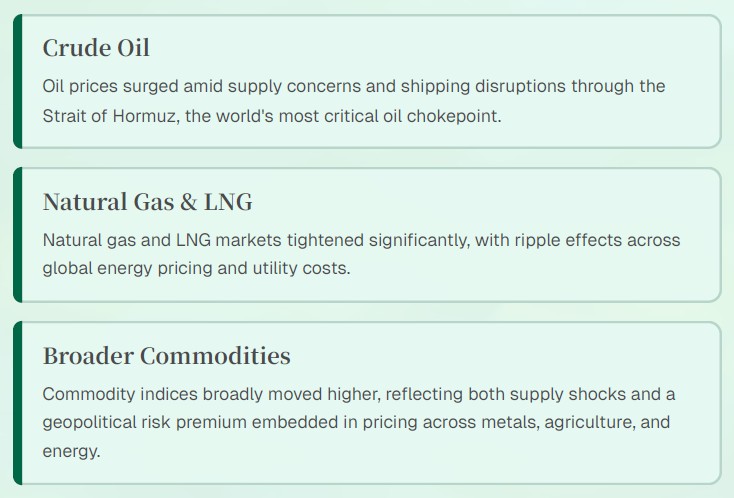

Figure 1 | Volatility Has Risen but Remains Far Below Many Periods in the Past
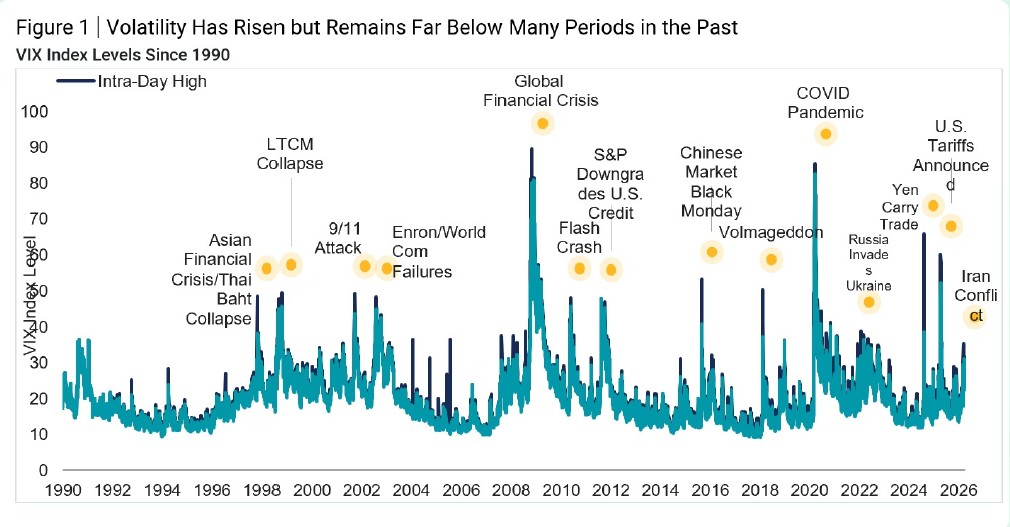
VIX Index Levels Since 1990. Source: Bloomberg. Past performance is not indicative of future results.
The VIX Index — Wall Street’s “fear gauge” — rose materially during Q1 2026 as the Iran conflict unfolded. However, as the chart below illustrates, current volatility levels remain well below the spikes seen during historical crises such as the Global Financial Crisis, COVID-19, and the post-9/11 period. Context matters: elevated volatility is uncomfortable, but it is not unprecedented.
Late-Quarter Developments: Tentative Signs of Relief
De-Escalation Signals
Important Caveats
Toward the end of Q1, tentative signs of de-escalation began to emerge, providing some relief to markets:
- Oil prices stabilized but remained elevated relative to the start of the year
- Equity markets recovered modestly from their intra-quarter lows
- Diplomatic channels showed early signs of engagement
The durability of any ceasefire remains deeply uncertain. Markets continue to react quickly — and sometimes sharply — to incremental geopolitical
developments. Investors should not interpret stabilization as resolution.
Volatility persists, and the situation warrants close monitoring. The next quarter’s market direction will hinge significantly on whether de-escalation holds or tensions re-intensify.
Key Takeaways for Investors
The Case for Staying Invested
Staying invested during periods of war has historically proven to be a prudent long-term strategy, despite the short-term volatility such events create. Markets tend to react quickly and emotionally to geopolitical shocks — often pricing in worst-case scenarios early — which can lead to sharp but temporary declines.

> Markets Adapt
Over time, economies adapt, policy responses stabilize conditions, and corporate earnings continue to grow —
allowing markets to recover and
ultimately move higher.
> Recovery Periods are Critical
Missing even a small number of recovery days can significantly impact long-term returns. The cost of being out of the market at the wrong time is often far greater than enduring volatility.
> Discipline Compounds
For long-term investors, maintaining discipline during periods of conflict helps ensure participation in the eventual rebound and the compounding
benefits that equities provide over time.
Looking Ahead: Q2 2026 & Beyond
1
2
De-escalation
A sustained ceasefire could
ease inflation pressures,
support risk assets, and allow
the Fed to resume its rate cutting
path.
Re-escalation
Further conflict intensification
would likely reinforce volatility,
keep energy prices elevated,
and extend downside risks
across equities.
Our Commitment to You
The trajectory of the Iran conflict will remain central to market direction as we move into Q2 2026. At Verus, we will continue to monitor developments closely, assess their implications across asset classes, and adjust portfolios as warranted by evolving conditions.
We remain focused on positioning portfolios to weather near-term uncertainty while staying aligned with your long-term financial objectives. Thank you for your continued trust in Verus.
As always, the Verus team is by your side, guiding you through every market turn.
Important disclosure information
Please remember that past performance is no guarantee of future results. Different types of investments involve varying degrees of risk, and there can be no assurance that the future performance of any specific investment, investment strategy, or product (including the investments and/or investment strategies recommended or undertaken by Verus Financial Partners [“Verus”]), or any non-investment related content, made reference to directly or indirectly in this commentary will be profitable, equal any corresponding indicated historical performance level(s), be suitable for your portfolio or individual situation, or prove successful.
Due to various factors, including changing market conditions and/or applicable laws, the content may no longer be reflective of current opinions or positions. Moreover, you should not assume that any discussion or information contained in this commentary serves as the receipt of, or as a substitute for, personalized investment advice from Verus. No amount of prior experience or success should not be construed that a certain level of results or satisfaction if Verus is engaged, or continues to be engaged, to provide investment advisory services.
Verus is neither a law firm, nor a certified public accounting firm, and no portion of the commentary content should be construed as legal or accounting advice. A copy of the Verus’ current written disclosure Brochure discussing our advisory services and fees continues to remain available upon request or at www.verusfinancialpartners.com.
Please Remember: If you are a Verus client, please contact Verus, in writing, if there are any changes in your personal/financial situation or investment objectives for the purpose of reviewing/evaluating/revising our previous recommendations and/or services, or if you would like to impose, add, or to modify any reasonable restrictions to our investment advisory services. Unless, and until, you notify us, in writing, to the contrary, we shall continue to provide services as we do currently.
Please Also Remember to advise us if you have not been receiving account statements (at
least quarterly) from the account custodian.
Historical performance results for investment indices, benchmarks, and/or categories have been provided for general informational/comparison purposes only, and generally do not reflect the deduction of transaction and/or custodial charges, the deduction of an investment management fee, nor the impact of taxes, the incurrence of which would have the effect of decreasing historical performance results. It should not be assumed that your Verus account holdings correspond directly to any comparative indices or categories.
Please Also Note: (1) performance results do not reflect the impact of taxes; (2) comparative benchmarks/indices may be more or less volatile than your Verus accounts; and, (3) a description of each comparative benchmark/index is available upon request.
Latest Posts
-
2026 Q3 Investment Report
Third Quarter Financial Market Review The third quarter reminded investors that market indexes ca…
-

Thank You, Richmond Times Dispatch
We would like to express our sincere appreciation to the Richmond Times-Dispatch for including Ve…
-

A Special Thank You to All Access
We’re excited to share a special thank you to the team at All Access for the incredible opportuni…